
VELTEZOM POWDER FOR SOLUTION FOR INJECTION 3.5MG
4.1. Therapeutic indications
VELTEZOM is indicated as part of combination therapy for the treatment of patients with previously untreated multiple myeloma.
VELTEZOM is indicated as monotherapy for the treatment of patients with multiple myeloma who have received at least 1 prior therapy.
VELTEZOM is indicated as monotherapy for the treatment of patients with mantle cell lymphoma who have received at least 1 prior therapy.
VELTEZOM in combination with rituximab, cyclophosphamide, doxorubicin and prednisone is indicated for the treatment of adult patients with previously untreated mantle cell lymphoma who are unsuitable for haematopoietic stem cell transplantation.
4.3. Contraindications
VELTEZOM is contraindicated in patients with acute diffuse infiltrative pulmonary and pericardial disease and hypersensitivity to bortezomib, boron, or mannitol.
4.2. Posology and method of administration
Bortezomib may be administered:
- Intravenously (at a concentration of 1 mg/ml) as a 3 to 5 second bolus injection or
- Subcutaneously (at a concentration of 2.5 mg/ml)
Because each route of administration has a different reconstituted concentration, caution should be used when calculating the volume to be administered.
At least 72 hours should elapse between consecutive doses of bortezomib.
VELTEZOM IS FOR INTRAVENOUS OR SUBCUTANEOUS USE ONLY. Intrathecal administration has resulted in death.
Monotherapy
Relapsed Multiple Myeloma and Relapsed Mantle Cell Lymphoma
Recommended Dosage
The recommended dose of bortezomib is 1.3 mg/m2/dose administered twice weekly for 2 weeks (Days 1, 4, 8, and 11) followed by a 10-day rest period (Days 12–21). For extended therapy of more than 8 cycles, bortezomib may be administered on the standard schedule or, for relapsed multiple myeloma, on a maintenance schedule of once weekly for 4 weeks (Days 1, 8, 15, and 22) followed by a 13-day rest period (Days 23 to 35) (see Clinical Trials section for a description of dose administration during the trials – please refer to the Product Insert/Patient Information Leaflet published on HSA for the full drug information). At least 72 hours should elapse between consecutive doses of bortezomib.
Dose Modification and Re-initiation of Therapy
Bortezomib therapy should be withheld at the onset of any Grade 3 non-hematological or Grade 4 hematological toxicities excluding neuropathy as discussed below (see section 4.4 – please refer to the Product Insert/Patient Information Leaflet published on HSA for the full drug information). Once the symptoms of the toxicity have resolved, bortezomib therapy may be reinitiated at a 25% reduced dose (1.3 mg/m2/dose reduced to 1.0 mg/m2/dose; 1.0 mg/m2/dose reduced to 0.7 mg/m2/dose).
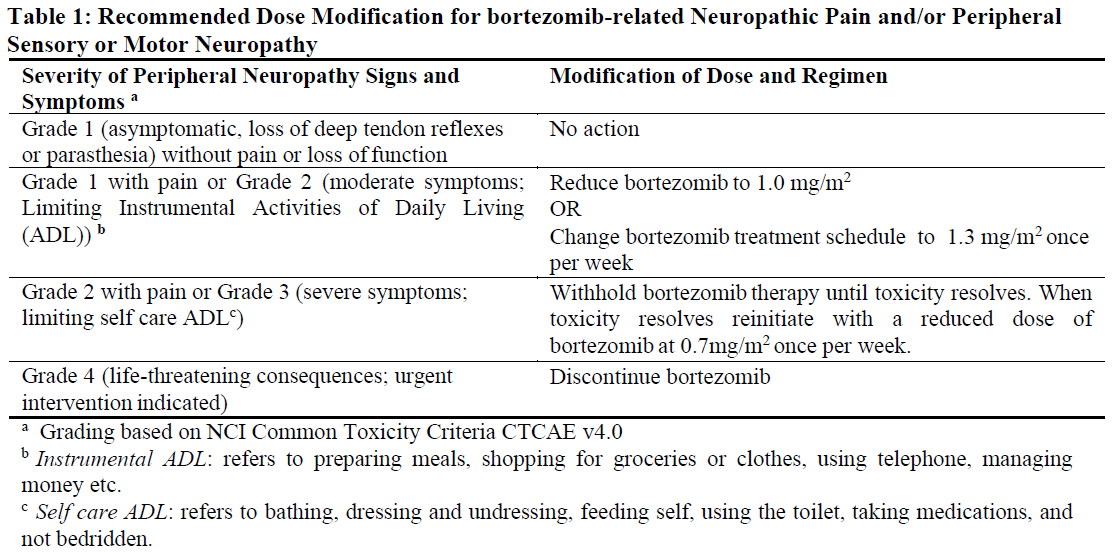
Table 1 contains the recommended dose modification for the management of patients who experience bortezomib-related neuropathic pain and/or peripheral neuropathy. Severe autonomic neuropathy resulting in treatment interruption or discontinuation has been reported. Patients with pre-existing severe neuropathy should be treated with bortezomib only after careful risk-benefit assessment.
Administration
Bortezomib is administered intravenously or subcutaneously. When administered intravenously, bortezomib is administered as a 3–5 second bolus intravenous injection through a peripheral or central intravenous catheter followed by a flush with 0.9% sodium chloride solution for injection. For subcutaneous administration, the reconstituted solution is injected into the thighs (right or left) or abdomen (right or left). Injection sites should be rotated for successive injections.
If local injection site reactions occur following bortezomib injection subcutaneously, a less concentrated bortezomib solution (1 mg/ml instead of 2.5 mg/ml) may be administered subcutaneously, or changed to IV injection.
Combination Therapy
Previously Untreated Multiple Myeloma
Recommended Dosage in Combination with Melphalan and Prednisone
Bortezomib is administered in combination with oral melphalan and oral prednisone for nine 6-week treatment cycles as shown in Table 2. In Cycles 1–4, bortezomib is administered twice weekly (days 1, 4, 8, 11, 22, 25, 29 and 32). In Cycles 5–9, bortezomib is administered once weekly (days 1, 8, 22 and 29). At least 72 hours should elapse between consecutive doses of bortezomib.

Dose Management Guidelines for Combination Therapy with Melphalan and Prednisone
Dose modification and reinitiation of therapy when bortezomib is administered in combination with melphalan and prednisone.
Prior to initiating a new cycle of therapy:
- Platelet count should be ≥70 x 109/L and the absolute neutrophil count (ANC) should be ≥ 1.0 x 10⁹/L
- Non-hematological toxicities should have resolved to Grade 1 or baseline

For additional information concerning melphalan and prednisone, see manufacturer's prescribing information.
Previously Untreated Mantle Cell Lymphoma Patients Not Eligible for Haematopoietic Stem Cell Transplantation
Recommended Dosage in Combination with Rituximab, Cyclophosphamide, Doxorubicin and Prednisone
For bortezomib dosage, see Monotherapy. Six bortezomib cycles are administered. For patients with a response first documented at Cycle 6, two additional bortezomib cycles are recommended.
The following medicinal products are administered on Day 1 of each bortezomib 3 week treatment cycle as intravenous infusions: rituximab at 375 mg/m2, cyclophosphamide at 750 mg/m2, and doxorubicin at 50 mg/m2. Prednisone is administered orally at 100 mg/m2 on Days 1, 2, 3, 4 and 5 of each treatment cycle.
Dose Adjustments during Treatment for Patients with Previously Untreated Mantle Cell Lymphoma
Prior to the first day of each cycle (other than Cycle 1):
- Platelet count should be ≥ 100 x 109/L and absolute neutrophil count (ANC) should be ≥ 1.5 x 10⁹/L
- Hemoglobin should be ≥ 8 g/dL (≥ 4.96 mmol/L)
- Non-hematologic toxicity should have recovered to Grade 1 or baseline
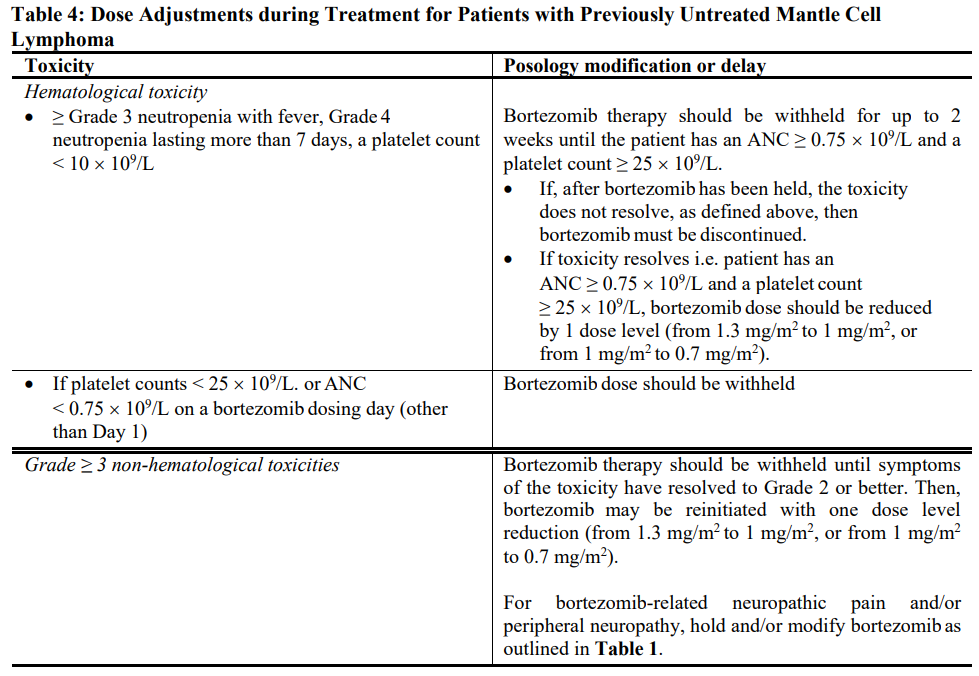
Bortezomib treatment must be withheld at the onset of any Grade 3 non-hematological or Grade 3 hematological toxicities, excluding neuropathy. For dose adjustments, see Table 4 below.
For dosing instructions for rituximab, cyclophosphamide, doxorubicin, or prednisone, see manufacturer's prescribing information.
Special Populations
Patients with Renal Impairment
The pharmacokinetics of bortezomib are not influenced by the degree of renal impairment. Therefore, dosing adjustments of bortezomib are not necessary for patients with renal insufficiency. Since dialysis may reduce bortezomib concentrations, the drug should be administered after the dialysis procedure (see section 5.2 – please refer to the Product Insert/Patient Information Leaflet published on HSA for the full drug information).
Patients with Hepatic Impairment
Patients with mild hepatic impairment do not require a starting dose adjustment and should be treated per the recommended bortezomib dose. Patients with moderate or severe hepatic impairment should be started on bortezomib at a reduced dose of 0.7 mg/m2 per injection during the first cycle, and a subsequent dose escalation to 1.0mg/m2 or further dose reduction to 0.5mg/m2 may be considered based on patient tolerance (see Table 5).

